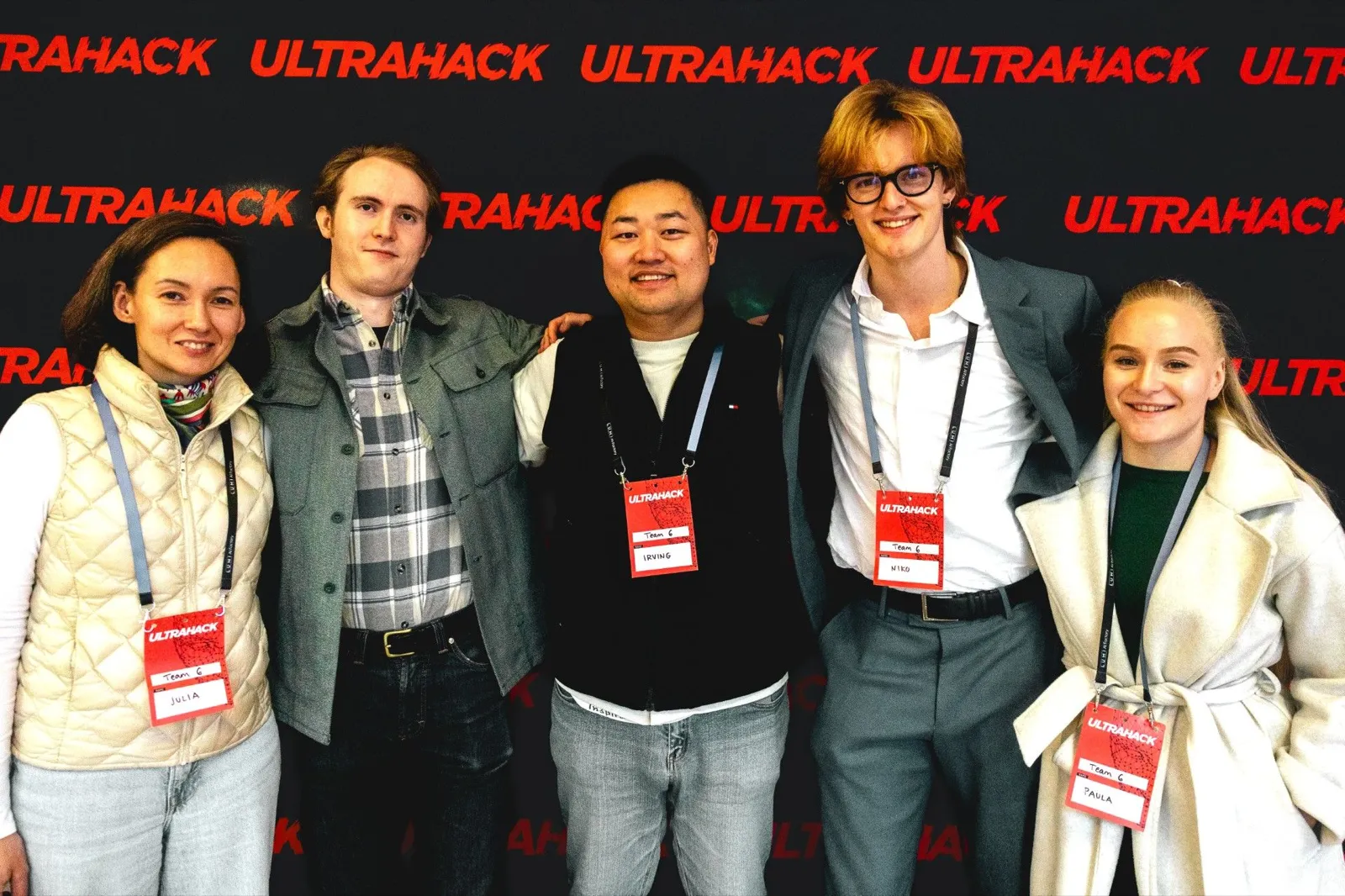
The Quantum x Finance Hackathon in Helsinki in October 2026 drew 24 teams working on sustainable finance with quantum computing and AI. First place went to MetsäQ, a team from Hanken School of Economics, which uses quantum optimisation to value forests and find the best time to harvest them.
Key terms
- Hackathon: teams build a working prototype around one challenge in a few days, and a jury ranks the results.
- Quantum computing: computing based on quantum physics, suited to problems where you must find the best option among a very large number of combinations.
- QUBO (quadratic unconstrained binary optimisation): a way to write a "which choice pays best?" problem so a quantum computer can work on it.
- Precision forestry: managing forests with sensors, satellites and data analysis instead of relying only on manual surveys and experience.
- Monte Carlo simulation: running a very large number of random trials to estimate how bad the worst case could be; the quantum version aims to make those trials faster.
- LiDAR: laser scanning of the ground and trees, used to measure tree height and forest density.
- Sustainable finance: lending and investing that takes environmental, social and governance (ESG) risk into account.
- LUMI AI Factory: AI computing capacity in Finland, built around the LUMI supercomputer under the EU's AI Factories programme.
What happened at the hackathon?
Ultrahack organised the event together with Hanken. It took place in Helsinki, and Ultrahack's event page lists 8 to 10 October 2026.
- Teams: 24. The 2025 edition at Hanken (9 to 11 October 2025) had 14 teams, so participation rose by roughly 70%.
- Resources: participants could use quantum and AI infrastructure from IQM, IBM, LUMI AI Factory and VTT, with expert support.
- Prizes: six teams received prizes.
What did the winning team, MetsäQ, build?
MetsäQ's tagline is "The right tree, right price, right time." The team has five members, four of them from Hanken. A team member calls the product a "Bloomberg for Forestry": a dashboard for investors, forestry companies and regulators that tracks forest asset losses and prices the risk.
The team describes the problem in specific terms. Traditional airborne LiDAR can measure tree height and standing timber volume, but dense canopies make data on the lower trunks unreliable, and the hidden asset losses caused by extreme weather follow complicated paths.
The solution has two layers:
- Seeing accurately: AI combines multi-channel satellite radar with open forestry data to catch changes in the forest as they happen. LiDAR and pre-trained quantum AI models then estimate what a forest is worth.
- Pricing the risk: for losses caused by supply-chain swings, natural disasters and ESG compliance, the team used quantum Monte Carlo simulation for dynamic pricing of extreme risk and for securitisation assessment, and QUBO to pick the best harvest timing among many plans. The team says this runs in seconds where a classical computer needs days. That is the team's own claim and has not been independently verified.
The team member says the judges included experts from PwC, VTT, OP Bank, IBM and IQM.
Why forests? Forests are a major economic asset in Finland, and valuation and harvest timing directly affect returns. The result is a prototype built in a few dozen hours, not a commercial product that is live today.
Opportunities for Finland's and the EU's tech sector
- Finance and insurance: how to put a price on natural assets such as forests and farmland is a gap in sustainable finance. MetsäQ showed one route: value with satellite and LiDAR data, then calculate risk with quantum computing. Lenders, insurers and asset managers have a new valuation method to study.
- Forestry and natural-resource companies: LiDAR and satellite data are already in use. Connecting them to optimisation takes the work from "looking at the trees" to "working out the price and the timing".
- Quantum and AI start-ups in Finland: IQM, IBM, VTT and LUMI AI Factory opened their resources to participants, so a new team can get quantum and AI compute and experts within a few dozen hours and turn an idea into a prototype. That is how MetsäQ was built.
- Finnish universities and research institutes: entries grew from 14 teams to 24 in a year, and academia, research bodies and industry met at one event, where new collaborations can start.
How Open Editor sees it
Congratulations to the MetsäQ team. Turning LiDAR, satellite data and quantum computing into a working prototype in a few dozen hours is not easy.
Entries rose from 14 teams last year to 24, so the quantum-and-finance community around Helsinki is growing. IQM, IBM, VTT and LUMI AI Factory all opened their resources to participants, which put research institutions, hardware companies and the finance community in the same event, something not often seen elsewhere.
Quantum computing is still some way from large-scale commercial use, and MetsäQ is still a prototype. OpenCompute Labs will keep following events like this in Finland's technology and finance scene and report on further developments.
Frequently asked questions
What is MetsäQ?
MetsäQ is the winning project of Quantum x Finance Hackathon 2026. It uses quantum optimisation to value forests and find the best harvest time. "Metsä" is the Finnish word for forest.
Where was the hackathon held?
In Helsinki, Finland. Ultrahack organised it, with Hanken School of Economics as the academic partner.
Can foreign companies or students take part?
Entry rules for this series are set each year on the Ultrahack event page, and registration details for the next edition will appear there.
What does MetsäQ's product look like?
The team calls it a "Bloomberg for Forestry": a risk-monitoring and pricing dashboard for investors, forestry companies and regulators. For now it is a hackathon prototype.
Is quantum computing ready for commercial use?
Most quantum applications are still at the experimental and prototype stage. The hackathon results show what the methods could do, not services that are already running.
Sources
- Hanken School of Economics LinkedIn post
- Ultrahack: Quantum x Finance Hackathon
- Hanken: report on the 2025 quantum hackathon
Sources checked on 18 October 2026.